
PNG Ports, Gateways and Inland Logistics: Getting Cargo from the Wharf to Where It’s Needed
In Papua New Guinea, choosing a port is really choosing a route. This guide explains how PNG’s ports, roads, coastal ships and domestic flights fit together, so you can plan freight all the way to its final destination.
In this guide
- Lae and Port Moresby handle more than 70% of cargo through PNG’s declared ports, and Lae alone handles about half.
- Port Moresby has no road link to Lae or the Highlands, so the wrong entry port means a second sea or air leg.
- The Highlands Highway from Lae is the main road corridor into the Highlands, and its condition and security shape transit times.
- Island provinces rely on coastal shipping, and many remote sites on domestic air freight and charters.
- Warehousing and consolidation in Lae and Port Moresby can reduce handling, detention and inland transport costs.
Why PNG logistics doesn’t end at the wharf
Most of PNG’s imports arrive through a handful of ports, but the businesses and projects they’re bound for are spread across rugged mountains, river valleys and hundreds of islands. Port Moresby, the capital, isn’t connected by road to Lae or the Highlands, and the Highlands, home to about 40% of the population, are reached by a single main highway from Lae.
That geography makes the inland leg a core part of every shipment rather than an afterthought. A container can reach PNG on schedule and still be weeks from its final destination if the port, the onward mode or the timing is wrong.
This part of our complete guide to shipping freight to PNG covers the ports, gateways and domestic networks that move cargo around the country. Each section below summarises the essentials and links to a detailed guide.
PNG’s ports at a glance
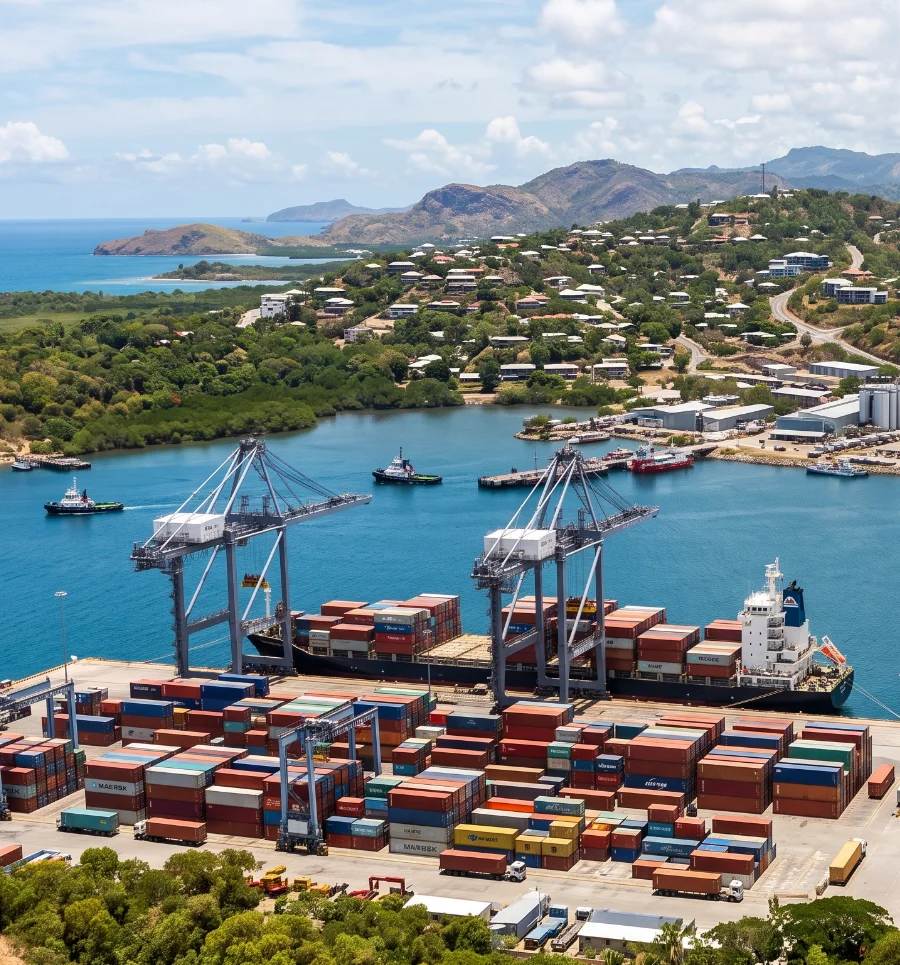
PNG has 23 declared ports, along with many smaller wharves and jetties. PNG Ports Corporation, the state-owned port authority, manages 15 of them. Only a few, however, have the infrastructure to handle significant international traffic as well as coastal shipping.
Lae and Port Moresby together account for more than 70% of the throughput across the declared ports, with Lae handling around half on its own. Kimbe and Rabaul are the next busiest, serving the New Britain economies.
| Port | Province | Main role |
|---|---|---|
| Lae | Morobe | Main international container gateway and start of the Highlands Highway |
| Port Moresby (Motukea) | National Capital District | Gateway for the capital and Central Province |
| Madang | Madang | International and coastal traffic for the north coast |
| Kimbe | West New Britain | International and coastal traffic, including oil palm exports |
| Rabaul | East New Britain | International and coastal traffic for the New Guinea Islands |
| Smaller ports | Various | Alotau, Kavieng, Lorengau, Buka, Kieta, Wewak, Vanimo, Oro Bay, Daru and Aitape, mainly served by coastal and feeder vessels |
Port Moresby vs Lae: choosing the right entry gateway
The rule of thumb is simple: ship to the port that sits closest, by a practical route, to where the cargo will be used.
- Choose Lae for Morobe, Madang by road, the Highlands provinces, and mine, gas and agricultural projects supplied along the Highlands Highway.
- Choose Port Moresby for the National Capital District, Central Province, and government, retail and construction work in and around the capital.
- For the islands, compare a direct international call at ports such as Rabaul or Kimbe with a coastal connection from Lae or Port Moresby.
If a consignment is going to more than one region, it’s often cheaper to split it at origin into separate shipments than to land everything at one port and move part of it again. Compare sailing frequency and transit times to each port as well. The cheapest ocean rate isn’t the cheapest landed cost if the cargo arrives in the wrong place.
The Port of Lae
Lae is PNG’s busiest port and the gateway for most cargo bound for the Highlands and the industrial centre of Morobe Province. International containers are handled at the South Pacific International Container Terminal (SPICT) in the Lae Tidal Basin, operated by ICTSI under a 25-year concession, while the older main wharf continues to handle a mix of vessels.
SPICT has two post-Panamax ship-to-shore cranes, the largest port cranes in PNG, capable of working vessels of up to around 6,000 TEU. Because Lae carries so much of the country’s trade, congestion or delays here flow through to other ports and to inland supply chains.
Lae’s location is its biggest advantage. The port sits at the start of the Highlands Highway, with road links into the Markham Valley, Madang and the Highlands, and the city is served by Nadzab airport, a declared international port of entry.
Go deeper
Port Moresby and Motukea
Port Moresby’s international cargo operations moved in 2018 from the old city wharf to Motukea Island, about 12 kilometres from the central business district. Motukea International Terminal (MIT), also operated by ICTSI, now handles container traffic for the capital.
Port Moresby is the natural entry point for cargo destined for the National Capital District and Central Province, including government, retail, construction and services. It’s also PNG’s main international air hub through Jacksons International Airport, which makes it the usual landing point for urgent air freight.
The limitation is reach. With no road link to Lae or the Highlands, cargo that lands in Port Moresby but is needed elsewhere has to continue by sea or air, so it pays to be certain about the final destination before you book.
Go deeper
Moving cargo from Port Moresby to Lae and the Highlands
Cargo sometimes ends up in Port Moresby when it’s needed in Lae or the Highlands. A supplier may have only quoted to the capital, a consignment may have been mixed, or the destination may have changed after booking. There are two ways to move it on.
By sea
Coastal and some international services connect Port Moresby and Lae. It’s the economical option for containers and heavy cargo, but you’ll pay handling at both ports and wait for a suitable sailing, which can add days or more.
By air
Domestic air freight from Jacksons to Nadzab, or direct to Highlands airports such as Mount Hagen, suits small, urgent or high-value items. It’s fast, but it’s charged by weight and limited by aircraft size, so it’s rarely economic for large consignments.
Either way, the second leg adds cost, handling and risk. The better fix is usually upstream: route Highlands-bound cargo directly into Lae, or ask your forwarder about a through bill of lading to the final port.
Trucking cargo via the Highlands Highway
The Highlands Highway, also known as the Okuk Highway, is the commercial lifeline of the Highlands. From Lae it runs up the Markham Valley and over the Kassam Pass to Kainantu and Goroka, then across the Daulo Pass and through Kundiawa to Mount Hagen, where it branches towards Enga, Hela and the Southern Highlands. The run from Lae to the Porgera area is around 700 kilometres.
Much of the highway is two-lane road, and landslides, washouts and potholes are a regular problem, particularly in heavy rain. Security on some sections is a genuine concern, and disputes with landowners can occasionally hold up traffic. Significant investment is under way: the Sustainable Highlands Highway Investment Program, backed by the Asian Development Bank, is rehabilitating more than 400 kilometres of the route and upgrading its bridges.
Operators who run the highway regularly plan around these conditions with convoy movements, driver monitoring, high-security seals and realistic schedules. For heavy or oversized loads, confirm axle limits, bridge capacities and any escort requirements before cargo leaves Lae. A few habits make a real difference:
- allow buffer days, especially during periods of heavy rain;
- use transport operators with established Highlands operations and security procedures;
- track loads and agree check-in points along the route;
- make sure your insurance covers the inland leg, not just the sea voyage.
Go deeper
Coastal shipping to the island provinces
Coastal shipping is how much of PNG’s freight reaches the island provinces and coastal towns without road links. Close to 250 vessels operate in the domestic trade, from container ships and general cargo vessels to landing craft that can work beaches and small jetties.
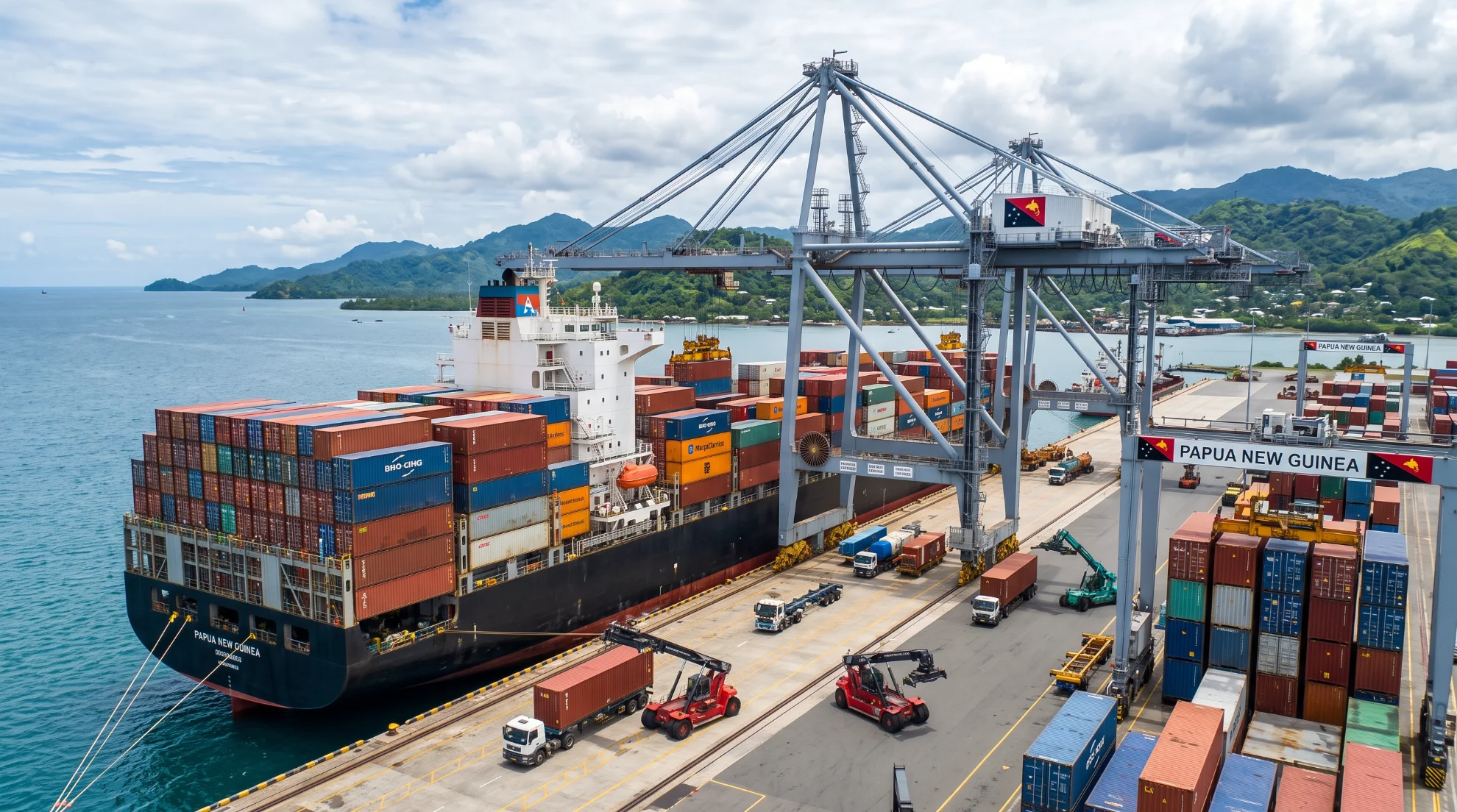
Lae is the main hub for outbound coastal containers, and Port Moresby serves much of the southern coast. Regular coastal services connect ports such as Madang, Wewak, Rabaul, Kimbe, Kavieng, Lorengau, Buka and Alotau.
Coastal schedules are often less frequent than international services, so planning the connection matters. Imported cargo is generally cleared through customs at its first port of entry before it moves on a domestic vessel. Allow time for clearance, collection and rebooking, or ask your forwarder to arrange the coastal leg as part of a through service.
Domestic air freight to remote areas
In much of PNG, flying is the only practical way in. Many mine sites, exploration camps, missions and rural communities are served by airstrips rather than roads, and domestic air freight carries everything from spare parts and medical supplies to food and fuel.
Scheduled domestic airlines carry cargo between the main centres, including Port Moresby, Lae, Mount Hagen and Rabaul, often in the holds of passenger aircraft or on small dedicated freighters that lift only a few tonnes per flight. Beyond that, fixed-wing charters reach smaller and unsealed airstrips, and helicopters can sling loads directly to sites with no strip at all.
The constraints are weight, dimensions and cost. Aircraft and airstrip limits cap what can move in a single flight, dangerous goods need special acceptance, and Highlands weather can ground flights. Pack cargo to fit the aircraft, not just the shipping container, and confirm piece weights and dimensions with the operator early.
Warehousing and consolidation in Lae and Port Moresby
Warehousing in Lae and Port Moresby gives importers more control over the inland leg. Rather than trucking each container straight to site, cargo can be unpacked near the port, stored securely and combined with other suppliers’ goods into full, efficient loads. Common uses include:
- consolidating several suppliers’ orders into full truckloads for the Highlands;
- unpacking containers promptly to return empties and avoid detention charges;
- holding buffer stock near the port to ride out road closures or shipping delays;
- staging project cargo so it moves to site in a planned sequence;
- storing goods under customs control in a licensed facility, where your broker confirms it suits your situation.
Security is a key consideration in both cities, so check fencing, guarding, insurance and stock control before choosing a facility.
Planning checklist for the inland leg
- Confirm the final delivery address and how it’s reached: road, coastal ship, air or a combination.
- Choose the entry port based on that route, not just the ocean freight rate.
- Check sailing frequency and the timing of coastal or domestic connections.
- Arrange customs clearance, trucking and any warehousing before the vessel arrives.
- Agree who is responsible for each leg, and confirm your insurance covers all of them.
- Build in buffer time for road conditions, weather and connections.
Frequently asked questions
Which is PNG’s busiest port?
Lae. It handles around half of the throughput across PNG’s declared ports and is the main gateway for cargo bound for the Highlands.
Can cargo be trucked from Port Moresby to Lae?
No. There’s no road link between the two cities, so cargo has to move between them by sea or air.
How does freight reach the island provinces?
Mostly by coastal shipping from Lae and Port Moresby. Some island ports, including Rabaul and Kimbe, also receive international calls.
Is air freight practical for the Highlands?
For small, urgent or high-value cargo, yes. Airports such as Mount Hagen are served by domestic flights, but costs are high and aircraft size limits what can be carried.
Should I unpack containers in Lae before sending cargo to the Highlands?
It depends. Sending a full container straight to site avoids extra handling, while unpacking and consolidating in Lae can cut costs when you’re combining several suppliers or need to return empty containers quickly.
Official sources

Philip Thomas
Philip is the lead author and editor at Phantom8. He writes practical guides to shipping freight into Papua New Guinea, with a focus on choosing the right port, clearing customs and planning the inland leg.
General information only. This guide is general in nature and isn’t legal, customs or logistics advice for your specific shipment. Port operations, road conditions and schedules change, so confirm the details with your freight forwarder, transport operator or the relevant authority before you ship.